First-party auto insurance sounds like dry legal fine print until you are sitting in an emergency room with a fractured wrist and an invoice for eight thousand dollars.
At that exact moment, you need to know who writes the first check.
For most American drivers, that initial layer of financial defense comes down to two acronyms: PIP (Personal Injury Protection) and MedPay (Medical Payments Coverage).
Both coverages share one major advantage: they pay out no matter who caused the crash. If you run a red light, hit a patch of black ice, or get rear-ended at a red light, both policies start paying without waiting for an adjuster to assign blame.
That is where the similarity ends.
MedPay is a narrow medical allowance. It pays doctors and hospitals, but nothing else. PIP is a broader economic safety net. It covers medical bills, but it also replaces lost paychecks, pays for substitute household chores, and provides survivor benefits.
Treating the two as identical is a fast way to get blindsided by lost income and unpaid household expenses while your injury claim is pending.
Direct Answer: How to Tell PIP and MedPay Apart Immediately
Here is the cleanest way to understand the difference:
- MedPay covers your body only. It pays for the physical treatment required to heal from a crash—ambulance rides, trauma doctors, diagnostic scans, physical therapy, and prescription drugs. It never pays for lost wages, childcare, or home maintenance.
- PIP covers your body and your budget. It covers the same medical care as MedPay, but also steps in to replace your lost income if your doctor takes you off work. It also pays for essential replacement services, such as babysitting, house cleaning, or grocery delivery.
Because both policies pay through your own insurance carrier, adjusters call them first-party benefits. You do not need to wait for a liability dispute to resolve before opening a claim.
What Does PIP Actually Cover?
State lawmakers created Personal Injury Protection to prevent injured drivers from sliding into financial ruin while waiting for bodily injury lawsuits to settle.
PIP rules differ from state to state, but standard policies generally include four main benefits:
- Necessary medical care: Hospital stays, emergency surgery, radiology scans, physical therapy, chiropractic sessions, and medical equipment like crutches or braces.
- Lost earnings: If your treating doctor confirms in writing that you cannot work due to crash injuries, PIP typically reimburses 60% to 80% of your gross lost income, up to weekly or monthly statutory caps.
- Replacement services: If injuries keep you from running your household, PIP reimburses reasonable costs for outside help. That covers daily childcare, home cleaning, lawn mowing, and grocery shopping.
- Funeral and survivor benefits: In fatal collisions, PIP provides a dedicated stipend for funeral and burial costs, along with limited survivor income for dependent family members.
PIP does not cover pain, emotional trauma, or loss of life enjoyment. To recover non-economic damages, you must pursue a bodily injury liability claim against the at-fault driver or check your potential recovery using our Car Accident Settlement Calculator.
What Does MedPay Cover?
Medical Payments coverage is a straightforward, optional policy endorsement found mostly in fault-based (tort) states. It is designed to act as an immediate bridge between a car crash and your regular health insurance deductible.
What MedPay pays for: - Ambulance and paramedic services - Emergency room care and trauma stabilization - X-rays, CT scans, and MRI imaging - Doctor visits, physical therapy, and chiropractic care - Dental repair for teeth broken in the collision - Funeral expenses up to the policy limit
What MedPay never pays for: - Lost wages: If you miss four weeks of work with a concussion, MedPay pays zero dollars toward your lost wages. - Household help: MedPay will not pay for childcare or housekeeping assistance. - Pain and suffering: Non-economic damages are completely excluded. - Vehicle damage: Repairs to your car are covered under collision or property damage insurance, never MedPay.
MedPay is popular because it almost never has a deductible or copay. If you carry a $5,000 MedPay limit and your emergency room bill totals $3,200, MedPay pays the entire $3,200, leaving $1,800 to cover future therapy copays.
PIP vs MedPay: Feature Comparison Table
| Coverage Feature | Personal Injury Protection (PIP) | Medical Payments (MedPay) |
|---|---|---|
| Primary Focus | Medical care plus household economic protection | Direct healthcare and funeral bills only |
| Fault Requirement | Pays regardless of who caused the accident | Pays regardless of who caused the accident |
| Medical Bills | Covered under state medical fee schedules | Covered up to stated policy dollar limit |
| Lost Wages | Yes (usually 60% to 80% of gross pay) | No (never reimburses missed income) |
| Household Help | Yes (reimburses childcare, cleaning, chores) | No (zero substitute service benefits) |
| Funeral Benefits | Yes | Yes (up to policy limit) |
| Deductible | Common in many states ($250 to $2,500) | Rarely carries any deductible ($0) |
| State Availability | Mandatory in no-fault states; optional in others | Optional in most states; required in very few |
| Typical Limits | $10,000 to $50,000+ (set by state rules) | $1,000 to $10,000 (sold in small tiers) |
| Lawsuit Rights | Often limits suing at-fault driver unless threshold met | Never restricts your right to sue at-fault driver |
Who Is Covered Under Your Policy?
First-party auto coverage protects more than just the person holding the steering wheel. Insurance contracts generally extend coverage to three groups:
- You and your resident family members: Both PIP and MedPay protect you when driving your car. In addition, resident relatives (spouses, children, and immediate family members residing in your household) are covered while riding in your car or even as passengers in someone else's vehicle.
- Passengers in your vehicle: Friends, coworkers, or relatives riding in your vehicle are typically covered under your MedPay or PIP policy. However, if a passenger owns their own insured car, state priority rules often require them to file under their own auto insurance first.
- Pedestrians and cyclists: In many no-fault states, if your vehicle hits a pedestrian or cyclist, your PIP policy is required by law to pay their initial emergency medical bills. MedPay sometimes covers you if you are struck by a vehicle while walking, but it rarely extends to pedestrians you hit.
Neither coverage pays out if the driver was committing an intentional crime, street racing, driving without permission, or using a personal car for unendorsed commercial activities like ridesharing or food delivery.
Which Policy Pays First? Working with Health Insurance
When a hospital bills for crash-related trauma care, they follow strict coordination of benefits (COB) rules:
- Step 1: Your auto insurance pays first. In most states, your auto policy (PIP or MedPay) is the primary payer. Clinics and hospitals bill your auto claim number until your first-party coverage balance reaches zero.
- Step 2: Your health insurance pays second. Once your auto insurer confirms in writing that your benefits are exhausted, your private health insurer (Blue Cross, Aetna, Kaiser) or Medicare/Medicaid steps in to process remaining eligible medical bills.
- Step 3: Subrogation and settlement liens. If another driver caused the collision, any insurer that paid your healthcare expenses has a legal right to seek repayment. The insurer places a medical lien on your personal injury settlement to recover their costs.
In a few states, such as New Jersey and Michigan, you can elect to make your private health insurance primary over PIP to reduce your auto insurance premiums. Only do this if you have verified that your health plan does not exclude motor vehicle accidents. Many employer-funded plans exclude auto accident coverage.
For a detailed look at handling hospital demands before liability is resolved, read our guide on who pays medical bills after a car accident while a claim is pending.
State Differences: The New York Case Example
First-party auto rules depend entirely on state law. A rule that applies in one state may be completely invalid across state lines.
To see how a strict statutory no-fault system works, consider New York:
- Mandatory $50,000 minimum: Under New York Department of Financial Services regulations, every registered passenger vehicle must carry at least $50,000 in Basic Economic Loss (PIP) per person.
- Covered benefits: That $50,000 covers reasonable and necessary medical treatments under state fee schedules, up to 80% of lost earnings from work (capped at $2,000 per month for up to three years), and up to $25 per day for up to one year for necessary household expenses.
- Strict 30-day notice rule: New York requires accident victims to submit written notice of their claim (Form NF-2) to the no-fault carrier within 30 calendar days of the crash. Missing this deadline without documented medical proof can cause a permanent loss of benefits.
- Serious injury threshold: In New York, you cannot sue the at-fault driver for pain and suffering unless your injuries qualify as a statutory "serious injury" (such as a fracture, significant disfigurement, or permanent impairment).
Do not assume New York's rules apply everywhere. Florida caps PIP at $10,000 and requires you to seek medical treatment within 14 days. California, Ohio, and Georgia do not have mandatory PIP systems at all; drivers there buy optional MedPay instead. Always check the specific laws of the state where your policy was purchased.
What Happens When Your Policy Limits Run Out?
When an auto insurer sends an exhaustion letter stating your first-party coverage has reached its dollar ceiling, take these four steps immediately:
- 1. Request an itemized payment ledger: Ask your adjuster for a complete list showing every provider paid, the date of service, and the exact dollar amount distributed.
- 2. Send the exhaustion letter to all providers: Send copies of the insurer's exhaustion letter and your private health insurance card to every clinic and billing office so they route future bills correctly.
- 3. Audit your Explanation of Benefits (EOB): Make sure your health insurer applies its contracted in-network discounts. Providers cannot bill you for contracted write-offs.
- 4. Track out-of-pocket expenses: Save every receipt for copays, deductibles, medications, and medical travel mileage. These form a major component of your claim against the at-fault driver, which you can track with our Personal Injury Settlement Calculator.
How to Check Your Auto Insurance Declarations Page
You do not need to call your agent to find out whether you have PIP or MedPay. Look at your Auto Insurance Declarations Page (the summary page sent when you buy or renew your policy):
- Find Part B or First-Party Benefits: Look for line items titled "Medical Payments" or "Personal Injury Protection".
- Check the dollar limit: If you see `$5,000 each person`, you have basic MedPay. If it reads `$50,000` with lines for lost wages, you carry PIP.
- Review your deductible: If you have PIP, check whether you selected a $250, $500, or $1,000 deductible. MedPay rarely carries a deductible.
- Check for work-loss exclusions: In some no-fault states, policyholders can exclude wage loss to lower their annual premium. If you signed this exclusion, you cannot claim lost wages after a crash.
Real-World Case Study: MedPay vs PIP in Action
To understand how these coverage differences impact an injured driver's finances, consider this hypothetical example involving two drivers who suffer identical injuries in different states.
The accident losses: - Medical bills: $16,000 (Ambulance, emergency department care, imaging scans, orthopedic specialist, and 8 physical therapy sessions). - Lost income: $4,500 (Six weeks away from work as an hourly supervisor earning $750 per week). - Total economic losses: $20,500.
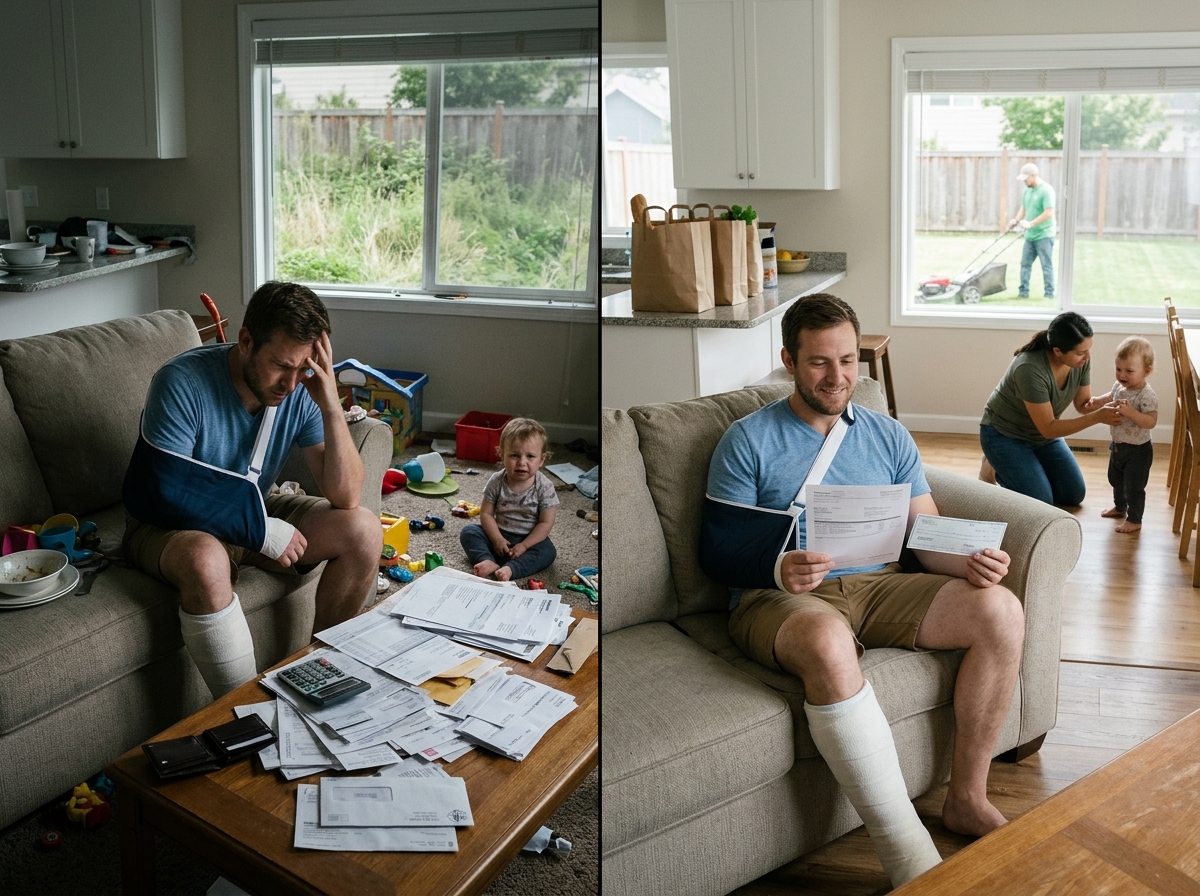
Scenario A: Driver with $5,000 MedPay (Fault State) - First-party medical payout: MedPay pays the first $5,000 of hospital and imaging bills directly. The MedPay limit is now 100% exhausted. - Remaining medical charges ($11,000): The driver gives the remaining $11,000 to their health insurer. The health plan applies network discounts, adjusts the allowable bill to $6,500, pays $5,200, and leaves the driver with a $1,300 balance in deductibles and copays. - Lost income reimbursement ($4,500): MedPay pays $0. MedPay never covers lost wages. The driver must absorb the entire $4,500 income loss out of pocket while waiting months or years for a settlement from the at-fault driver's insurance. - Immediate cash-flow shortfall: $5,800 ($1,300 medical balance + $4,500 lost wages).
Scenario B: Driver with $50,000 PIP (No-Fault State) - First-party medical payout: The driver carries a $500 deductible. Under state fee schedules, PIP pays the remaining $15,500 in medical bills directly to the doctors and hospital. - Lost income reimbursement: After receiving the treating doctor's disability note and employer wage verification, PIP pays 80% of the $4,500 lost wages ($3,600) via direct deposits. - Remaining policy balance: Out of the $50,000 PIP limit, the driver used $15,500 for medical care and $3,600 for lost earnings ($19,100 total), leaving $30,900 in remaining PIP protection for future therapy. - Immediate cash-flow shortfall: $1,400 ($500 deductible + $900 unpaid wage difference).
| Financial Metric | Scenario A (MedPay) | Scenario B (PIP) |
|---|---|---|
| Total Healthcare Bills | $16,000 | $16,000 |
| Auto Insurance Paid | $5,000 (Maximum limit) | $15,500 (Under fee schedule) |
| Lost Wages Reimbursed | $0 (Not covered) | $3,600 (80% wage benefit) |
| Immediate Out-of-Pocket Gap | $5,800 | $1,400 |
| Financial Stress on Household | High cash-flow crisis | Manageable transition |
(This scenario is an educational illustration. Actual results depend on state law, provider networks, policy terms, and fault determinations.)
Statutory Calculator
Calculate your car accident settlement
Adds vehicle damage and the other driver's insurance limit.